


PEM Fuel Cell System Selection Guide for Industrial and Commercial Applications
Updated: 13 hours ago
# The Comprehensive Guide to PEM Fuel Cell Technology
Introduction: The Rise of Hydrogen Fuel Cell Technology
In recent years, the hydrogen energy industry has experienced significant growth, leading to an increased focus on fuel cell technology across various sectors. According to market research firm Allied Market Research, the global fuel cell market is projected to reach $84.8 billion by 2030, with Proton Exchange Membrane Fuel Cells (PEMFC) emerging as the most prominent technology.
From backup power and drone propulsion to heavy-duty trucks and rail transit, PEM fuel cells are continually expanding into new application scenarios. This expansion is largely due to their advantages, including low-temperature quick start, high power density, and strong environmental adaptability. An increasing number of university laboratories and industrial research institutions are deploying PEMFC test platforms to accelerate technological innovation and industrialization.
As a high-tech company focused on the industrialization of PEM fuel cells, we have compiled this PEM Fuel Cell System Selection Guide to serve as a reference for scientific research institutions and industrial users, facilitating the successful implementation of more PEM fuel cell projects.
How PEM Fuel Cells Work
To select a PEM fuel cell system correctly, it is essential to understand its working principles. A PEM fuel cell is a device that directly converts chemical energy into electrical energy. The core component of a PEM fuel cell is the proton exchange membrane (PEM).
PEM Membrane Structure & Properties
The PEM membrane is a thin, solid polymer electrolyte that conducts protons. It is sandwiched between an anode and a cathode, forming the heart of the fuel cell. The most commonly used PEM material is Nafion, a sulfonated tetrafluoroethylene-based fluoropolymer-copolymer discovered by DuPont.
Some key properties of PEM membranes include:
High proton conductivity (0.1 S/cm)
Low electronic conductivity
Low gas permeability
Good mechanical strength
Chemical and thermal stability up to 90°C
The thickness of proton exchange membranes used in fuel cells typically ranges from 50 to 175 μm. Thinner membranes exhibit lower ionic resistance but are more susceptible to mechanical failure and fuel crossover.
PEM Fuel Cell Reaction Process
In a PEM fuel cell, hydrogen is oxidized at the anode, generating protons (H⁺) and electrons. The protons are conducted through the PEM membrane to the cathode, while the electrons flow through an external circuit, creating electric current. At the cathode, oxygen is reduced and combines with the protons and electrons to form water. The overall reactions are:
Anode: H₂ → 2H⁺ + 2e⁻
Cathode: ½O₂ + 2H⁺ + 2e⁻ → H₂O
Some key PEMFC performance metrics include:
Cell voltage: 0.6-0.7 V
Power density: 0.5-1.0 W/cm²
Stack efficiency: 50-60%
Operating temperature: 30-100°C
To visualize the PEM fuel cell working principle, see the diagram below:

Latest PEM Catalyst Breakthroughs
One of the main challenges facing PEM fuel cells is the high cost of platinum catalysts required for the electrochemical reactions. However, recent advances in catalyst technology are driving down costs and improving performance.
In our previous article "China's PEM fuel cell breakthrough reduces platinum use and boosts power," we discussed how Chinese researchers have developed a new catalyst using cobalt-based zeolite imidazole frameworks (CoZIF) that reduces platinum loading by 30% while increasing power density. These PEM catalyst innovations are key to making fuel cells more affordable and accelerating commercialization.
PEM Fuel Cell System Specifications & Comparison
With a basic understanding of how PEM fuel cells work, let's dive into the key specifications and configurations you need to consider when selecting a system for your application.
Power Level Options
PEM fuel cell systems are highly scalable and can be configured for a wide range of power outputs. Some common options include:
| Power Level | Typical Applications |
|-------------|----------------------|
| 5 kW | Backup power, small drones |
| 10 kW | Light-duty vehicles, forklifts |
| 25 kW | Mid-size passenger cars |
| 50 kW | Commercial vehicles, buses |
| 100 kW | Heavy-duty trucks, locomotives |
| 500 kW+ | Grid-scale power, data centers |
For research institutions and universities, 5-50 kW PEMFC test platforms are most common, while commercial demonstration projects often deploy systems in the 100-500+ kW range.
Cooling Systems Comparison
Effective thermal management is critical for PEM fuel cell performance and durability. There are two main types of cooling methods:

Liquid-cooled systems are preferred for most industrial and heavy-duty applications, while air-cooling may be suitable for smaller, low-power systems with intermittent usage.
SCADA & Control Systems
For research and development applications, having a robust supervisory control and data acquisition (SCADA) system integrated with the PEMFC is essential. Key features to look for include:
Real-time monitoring of voltage, current, temperature, pressure, and flow rates
Data logging and export to CSV or databases
Programmable safety limits and alarms
Remote control and parameter adjustment
Integration with fuel cell test software and analysis tools
Many university hydrogen laboratories and industrial R&D centres are deploying PEM fuel cell systems with advanced SCADA capabilities to enable in-depth characterization and accelerate innovation.
PEM Fuel Cell Technology Comparison
While PEM fuel cells are the most widely commercialized type, there are several other fuel cell technologies available. Here's a quick comparison:
| Fuel Cell Type | Electrolyte | Operating Temp. | Efficiency | Power Density | Start-up Time |
|----------------|-------------|-----------------|------------|---------------|---------------|
| PEMFC | Polymer Membrane | 30-100°C | 40-60% | High | Seconds |
| SOFC | Solid Oxide | 600-1000°C | 50-65% | Low | Hours |
| MCFC | Molten Carbonate | 600-700°C | 45-55% | Moderate | Hours |
| AFC | Alkaline Solution | 60-90°C | 50-70% | Moderate | Minutes |
PEM fuel cells' low-temperature operation, high power density, and quick response make them uniquely suited for transportation and portable power applications. They also have strong potential in stationary power when hybridized with batteries or supercapacitors.
PEM Fuel Cell Application Scenarios
To illustrate the real-world potential of PEM fuel cell technology, let's look at some representative application cases:
Educational Institutions & Research Labs
The University of California, Irvine (UCI) has installed a 50 kW PEM fuel cell system as part of its renewable-powered microgrid and hydrogen fueling research station. The PEMFC is integrated with an advanced SCADA platform that logs over 10 GB of operational data per week, enabling students and researchers to track real-time efficiency and optimize control strategies.
Commercial Demonstration Projects
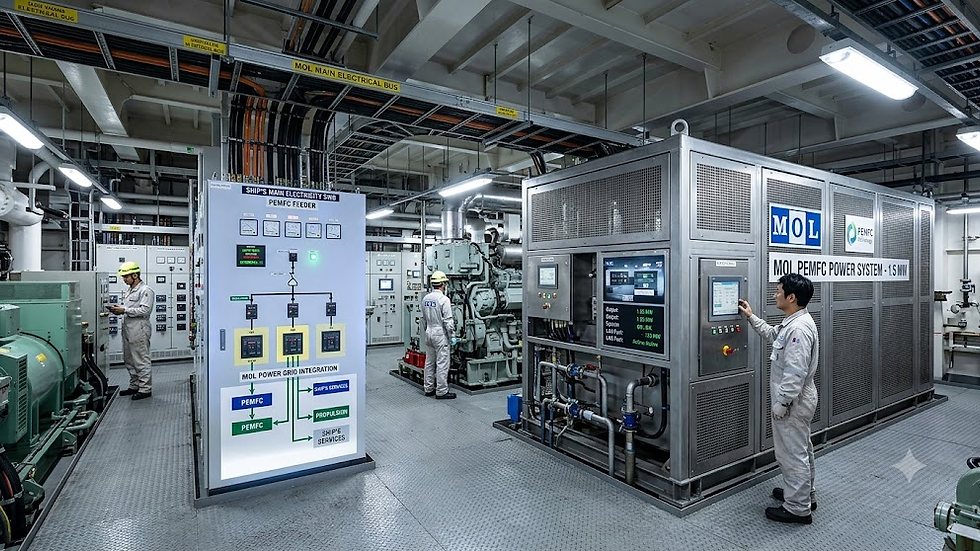
Mitsui O.S.K. Lines (MOL) is developing a 100 kW PEMFC generator as an alternative maritime power source for its car carriers and cruise ships when berthed. By integrating the fuel cell into the ship's electrical grid, MOL aims to reduce dockside emissions and save up to 50% on annual fuel costs compared to auxiliary diesel engines.
Distributor / OEM Partnerships
Hovogen is actively seeking distribution and OEM partners to integrate our advanced PEM fuel cell systems into their products and projects. Our engineering team works closely with customers to develop optimized PEM stack and balance-of-plant (BOP) configurations for your specific application requirements.
PEM Fuel Cell Procurement Guide
We have covered a lot of information about PEM fuel cell fundamentals and system options. Now let's walk through the key considerations and steps for selecting and procuring the optimal PEMFC solution for your needs.
Specification Checklist
Before requesting quotes from PEM fuel cell suppliers, ensure you have clearly defined your application requirements:
What is your required power level (kW) and voltage range (VDC)?
Will the PEMFC run continuously or intermittently? Estimate your duty cycle (%).
What are your physical size constraints and weight targets?
Do you need an air-cooled or liquid-cooled system?
What is your desired SCADA and data acquisition functionality?
Are there any special environmental or regulatory compliance needs?
Total Cost of Ownership (TCO) Analysis
The upfront capital expenditure (CapEx) of a PEM fuel cell is only part of the equation. To obtain a true picture of the economics, it is necessary to analyze the full total cost of ownership (TCO), which includes:
Fuel cell stack and BOP costs
Hydrogen fuel costs (₩/kg)
Planned and unplanned maintenance
Ancillary BoP component replacements
Decommissioning and recycling
For a research lab, the TCO of a 10 kW PEMFC over 10 years is approximately $250,000, while a 100 kW commercial system may be closer to $1.5M.
Delivery & Support
Lead times for PEM fuel cell systems vary based on power level and customization, but are typically in the range of 2-6 months. Key considerations for delivery and aftersales support include:
Factory acceptance testing (FAT) and site acceptance testing (SAT) protocols
Operator training and maintenance certification
Warranty terms and service-level agreements (SLA)
Availability of local technical support and spare parts
Our global service team is available 24/7 to support your PEMFC installation, commissioning, and ongoing maintenance needs.
Frequently Asked Questions (FAQ)
System Selection & Specifications
Q1: Should I choose an air-cooled or liquid-cooled PEM fuel cell system?
A: Liquid-cooled systems are preferred for high power density applications and steady-state operation, offering superior heat removal (< 2% parasitic power loss) and operating at 60–80°C. Air-cooled systems are suitable for lower power density, intermittent applications, though they incur higher parasitic losses (10–15%) and operate at 30–50°C. Your choice depends on power requirements, duty cycle, and thermal management constraints.
Q2: What is the typical cell voltage and power density of a PEM fuel cell?
A: PEM fuel cells operate at 0.6–0.7 V per cell with power densities of 0.5–1.0 W/cm². Stack efficiency typically ranges from 50–60%. For higher voltage outputs, multiple cells are stacked in series.
Q3: What SCADA and monitoring capabilities do I need?
A: For research and development applications, essential SCADA features include real-time monitoring of voltage, current, temperature, pressure, and flow rates; data logging to CSV or databases; programmable safety alarms; and remote parameter adjustment. Advanced integration with fuel cell test software enables in-depth characterization and optimization.
Performance & Technology
Q4: How does PEM fuel cell technology compare to other fuel cell types (SOFC, MCFC, AFC)?
A: PEM fuel cells operate at low temperatures (30–100°C) with quick startup times (seconds), making them ideal for transportation and portable power. Other technologies like SOFC operate at 600–1000°C with hours of startup time, while AFC operates at 60–90°C. PEM's high power density and rapid response make it the most suitable for applications requiring quick deployment and dynamic load changes.
Q5: What are the latest advances in PEM catalyst technology?
A: Recent breakthroughs in cobalt-based zeolite imidazole frameworks (CoZIF) have demonstrated a 30% reduction in platinum loading while increasing power density. These catalyst innovations are driving down costs and accelerating PEM fuel cell commercialization.
Q6: Can PEM fuel cells be integrated with renewable energy sources?
A: Yes, PEM fuel cells integrate well with hybrid energy systems. They can be combined with batteries or supercapacitors for stationary power applications, and their quick startup time allows them to respond rapidly to dynamic load demands in grid-connected and off-grid scenarios.
Economics & Total Cost of Ownership
Q7: What is the total cost of ownership (TCO) for a PEM fuel cell system?
A: TCO extends beyond upfront capital costs to include hydrogen fuel costs (₩/kg), planned and unplanned maintenance, balance-of-plant (BOP) component replacements, and decommissioning. For reference, a 10 kW research lab system costs approximately $250,000 over 10 years, while a 100 kW commercial system may reach $1.5M.
Q8: What factors influence the lifetime and durability of a PEM fuel cell system?
A: Key factors include operating temperature (optimal: 30–100°C), membrane thickness (typically 50–175 μm—thinner membranes reduce ionic resistance but increase susceptibility to mechanical failure), chemical and thermal stability, maintenance protocols, and duty cycle. Proper thermal management and adherence to operating specifications extend system lifespan.
Q9: What are the typical lead times and delivery timelines for PEM fuel cell systems?
A: Standard lead times range from 2–6 months depending on power level and customization requirements. Delivery support includes factory acceptance testing (FAT), site acceptance testing (SAT), operator training, and comprehensive warranty and service-level agreements (SLA).
Conclusion
PEM fuel cells are a powerful and versatile technology with vast potential to decarbonize transportation, stationary power generation, and industrial processes. As global momentum behind the hydrogen economy accelerates, organizations across sectors are racing to deploy commercial PEMFC solutions.


Comments