


Hydrogen Energy Research & Educational Training Systems
Industrial-Grade PEM Research & Education Solutions
Bridge the gap between theoretical physics and industrial application. Hovogen provides sophisticated, modular PEM (Proton Exchange Membrane) systems designed specifically for advanced research, university laboratories, and technical training centers.
Unlike standard educational kits, Hovogen units utilize the exact same aerospace-grade MEA technology found in our megawatt-scale industrial stacks, providing researchers with authentic, scalable data.
Empowering the next generation of engineers and researchers with advanced PEM electrolysis technology. Hovogen provides a vertically integrated suite of training workstations, from fundamental solar-to-hydrogen kits to industrial-grade R&D platforms with SCADA integration.
Advanced PEM Research Platform
HOV-ATX

Single Channel PEM Hydrogen Electrolyser Test Unit
For advanced electrochemistry studies and material science. This high-precision platform is designed for deep-dive analysis of PEM electrolysis performance.
Key Features
1. Multi-Scenario Testing Capabilities
• Technical Data: Supports constant current, constant voltage, and pulse loading modes.
• Simulates low-power operation (10% rated power) in off-grid environments to validate renewable energy compatibility.
• SCADA & PID Control: Real-time monitoring and control of current, voltage, and flow rates via PLC-based software.
• Polarization Curve Mapping: Automated variable load testing to analyze activation and ohmic losses.
2. Modularity and Scalability
• Core components (e.g., PEM electrolyzer, touch screen, power supply) are customizable based on client requirements.
3. Teaching Integration Design
• Includes experimental manuals and virtual simulation modules for hydrogen energy and electrochemistry courses.
• Material Testing Capability: "Open Innovation Lab" module allows for testing of custom catalyst coatings and flow field designs.
Integrated Hydrogen Training Workstation (Vocational/TVET)
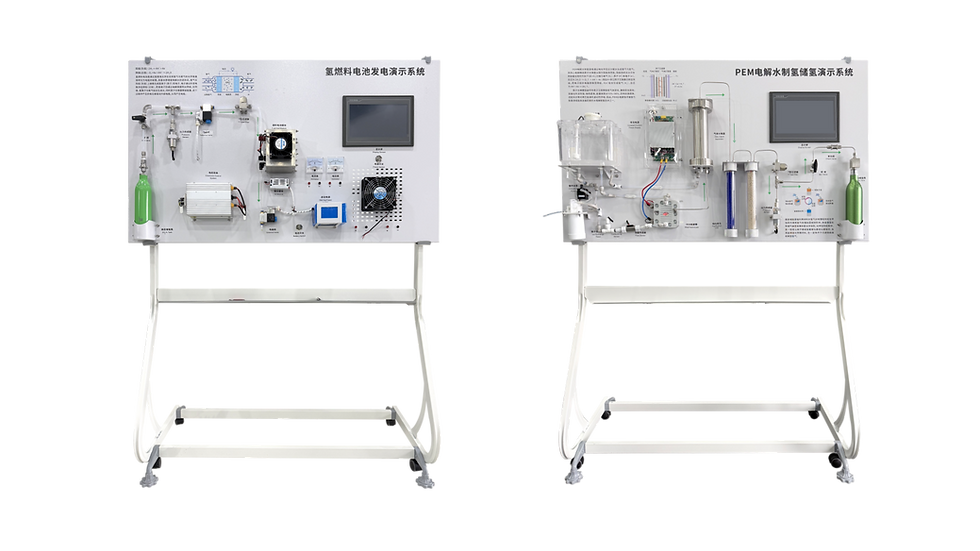
PEM Electrolysis Hydrogen Production and Storage Training Unit
HOV-DP-H2PS-500


A full-process "Production → Purification → Storage → Application" workstation. This modular system emphasizes system-level integration and industrial safety protocols.
The system employs pure water electrolysis, ensuring safety and reliability by avoiding alkaline contamination. With its modular design, visual interfaces, and real-time data monitoring, it enhances understanding of hydrogen processes, making it an essential tool for teaching and research in new energy, chemistry, and engineering.
Key features:
1. Teaching-Friendly Design
• Full-Process Visualization: Panels label process steps and principles with transparent clarity.
• Modular Design: Units can be independently disassembled for stepwise experiments (e.g., purification efficiency tests, storage capacity comparisons).
• Quantitative Data Analysis: Records parameters (current, voltage, water quality, flow rate, pressure) via MCGS screen for energy conversion rate calculations.
2. Cutting-Edge Technology
• Integrated PEM + Solid-State Storage: Covers the entire "production→purification→storage" chain.
3. Safety and Reliability
• Zero High-Pressure Risk: Solid-state storage pressure ≤1.6 MPa with no leakage risks; alkaline-free electrolysis avoids corrosion.
• Multi-Layer Protection: Automatic overpressure protection, gas leakage alarms, and compliance with educational safety standards.
4. Research Scalability
• Supported Topics: Voltage/current impact on hydrogen production rate, hydrogen storage material performance testing, wind-solar hybrid hydrogen system design.
• Expansion Interfaces: Compatible with photovoltaic/wind turbine simulators to build integrated "renewables→hydrogen production→storage→fuel cell" experimental platforms.
Hydrogen Fuel Cell Power Generation Training Unit
HOV-DP-FCPG-225
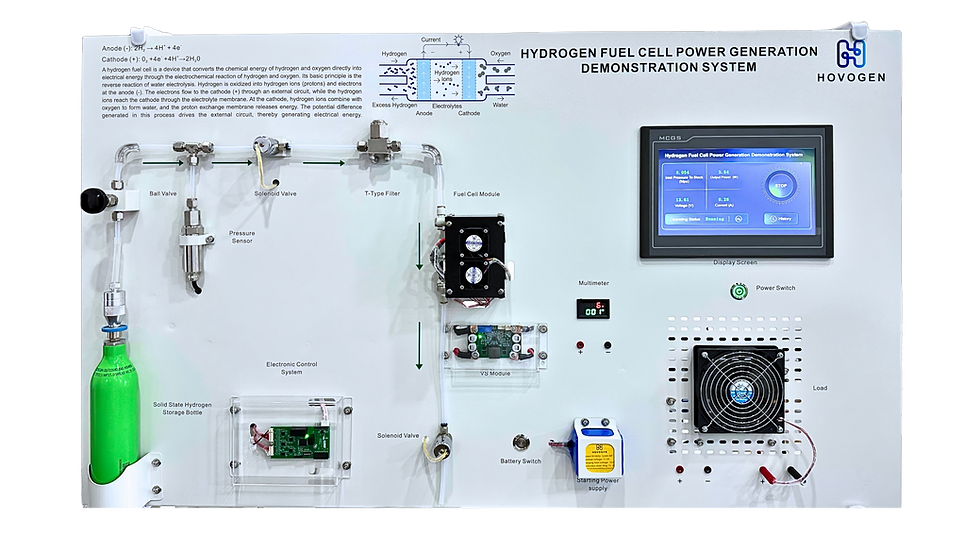

This system is a comprehensive hydrogen fuel cell power generation teaching demonstration device, specifically designed for universities and vocational colleges. It integrates solid-state hydrogen storage, fuel cell power generation, power management, and load application modules, effectively showcasing the core technology of converting hydrogen energy into electrical energy.
Utilizing Proton Exchange Membrane Fuel Cell (PEMFC) technology, the system features low-pressure solid-state hydrogen storage along with an intelligent monitoring system, ensuring both safety and reliability. It is ideal for experimental teaching and scientific research in fields such as new energy, chemical engineering, and electrical automation.
Key features:
1. Teaching-Friendly Design
· Full-Process Visualization: Panel labels and transparent structures illustrate hydrogen supply, power generation, and consumption.
· Modular Experiments: Supports step-by-step experiments (e.g., hydrogen purity impact on efficiency, load variation effects on voltage stability).
· Quantitative Data Analysis: Records parameters such as power efficiency and hydrogen utilization via the MCGS screen for research projects.
2. Cutting-Edge Technology
· Solid-State Storage: Uses low-pressure (≤1.6 MPa) solid-state hydrogen storage for maximum classroom safety (GB/T 24548-2021 compliant).
· High Localization Rate: 90% localization rate for fuel cell membrane electrodes, ensuring core component autonomy.
3. Triple Protection Mechanism:
Low-pressure solid-state hydrogen storage.
PLC-triggered overpressure shutdown.
Emergency pressure relief via exhaust solenoid valve, compliant with GB/T 24548-2021 fuel cell safety standards.
Photovoltaic Hydrogen Demonstration Unit
HOV-DP-PVK-60
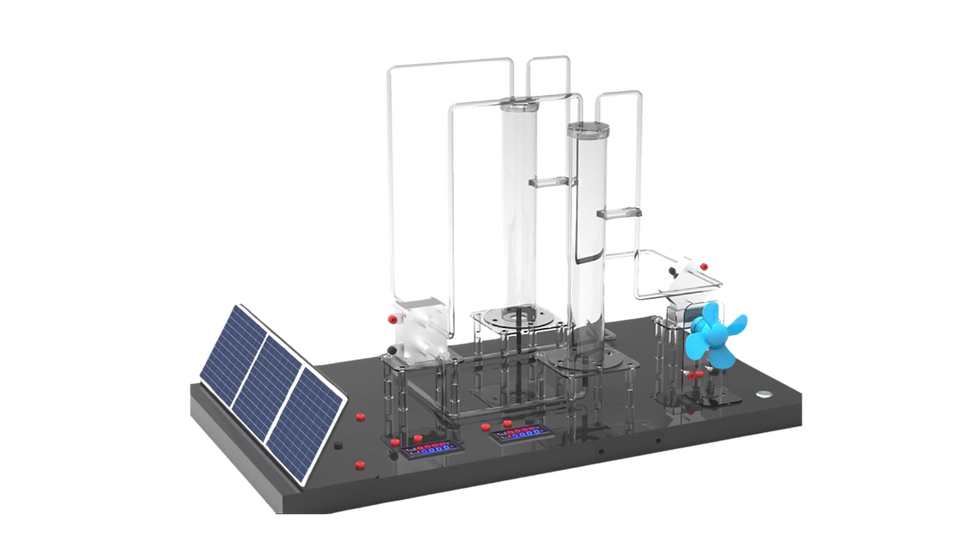
This self-contained educational system demonstrates renewable energy principles through a complete solar-to-hydrogen cycle. A high-efficiency solar module powers a PEM electrolyzer, splitting water into hydrogen and oxygen stored in dedicated tanks. When needed, these gases feed a PEM fuel cell to regenerate electricity, powering a fan for visual energy consumption feedback.
The closed-loop process illustrates key concepts: solar harvesting, electrolysis, gas storage, and fuel cell technology. Designed for classrooms (grades 8+), it enables hands-on experiments measuring energy efficiency, variable impacts, and electrochemical principles. Perfect for STEM demonstrations, science fairs, and renewable energy clubs, it safely prepares students for green technology careers while emphasizing operational safety.
Why Hovogen?
The Technical Advantage
To ensure your research meets global standards, our systems are built with the same core technology used in our industrial 200Nm³/h systems.
• 90% Localization Rate: Our membrane electrodes are developed in-house, ensuring that educational units reflect the latest breakthroughs in material science.
• Multi-Layer Safety: Features include automatic overpressure shutdown, PLC-triggered alarms, and zero-corrosion alkaline-free electrolysis.
• Data Connectivity: All systems feature USB/RS485 interfaces for professional data logging (CSV/Excel export) and integration with external simulation software.
Why Hovogen?
The Technical Advantage
To ensure your research meets global standards, our systems are built with the same core technology used in our industrial 200Nm³/h systems.
• 90% Localization Rate: Our membrane electrodes are developed in-house, ensuring that educational units reflect the latest breakthroughs in material science.
• Multi-Layer Safety: Features include automatic overpressure shutdown, PLC-triggered alarms, and zero-corrosion alkaline-free electrolysis.
• Data Connectivity: All systems feature USB/RS485 interfaces for professional data logging (CSV/Excel export) and integration with external simulation software.
Product Customization
In order to meet the specific needs of customers in different industries and fields, all products can be customized according to requirements. After many years of development, we have accumulated practical experience in many industries. For more details, please check out our projects, or talk to us.
